


Ensuring babies sleep safe and sound
PDF | 1.28 MB

The postnatal (postpartum) period covers the first six to eight weeks after the birth – a special time full of new experiences and changes. In this section, you can find out what to expect in the first few days in hospital. In addition, you will receive valuable tips on breastfeeding, learn exercises to help you regain your strength, and also find out what the ‘baby blues’ are all about, and why these mood swings can be quite normal.
Following a natural birth or a Caesarean section, your stay in the hospital generally lasts for four to seven days. During this time, you and your child will be cared for in our Maternity Ward by our specially trained nursing staff and medical specialists. In the private hospital, your personal gynaecologist will visit you once daily.

Our nursing staff will introduce you step by step to caring for your newborn child, offering you support and advice throughout your stay at the hospital. Perhaps you have already become familiar with some aspects during a baby care or birth preparation class. Now you will learn how to feed and care for your baby, and how to change its nappy; in no time you will feel secure and on top of the world with your new baby.
The offer may vary depending on the maternity hospital. For a comprehensive overview, we recommend consulting the respective pages of the individual maternity hospitals. In the private hospital, you will be visited every day by your personal gynaecologist.
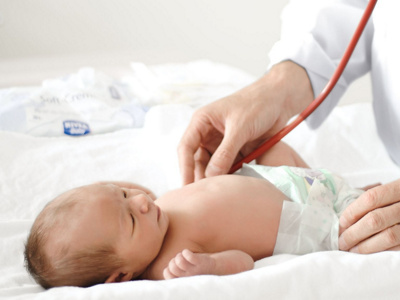
During your stay at the Maternity Ward, your newborn child will be thoroughly examined by a paediatrician.
Following their birth, many babies have what is known as “newborn jaundice”, which is usually perfectly harmless. If the jaundice measures above a certain level, the paediatrician may decide to treat your child with a special, harmless light procedure known as phototherapy.
If your baby requires specific medical care or monitoring, he or she be in the best hands with our paediatricians and specialist nursing staff. The modern medical and technological infrastructure of our clinics guarantees the greatest possible safety for newborn children. Our hospitals have state-of-the-art medical infrastructure that ensures safe and optimal care for newborns.
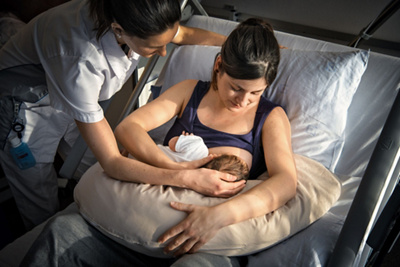
We recommend that you base your baby’s feeds on their thirst. After a short while, they will find their own rhythm of feeding, sleeping and being awake. The frequency of feeds and the amount your baby drinks are therefore very individual.
Breastfeed your baby at least five to six times within 24 hours, including at least once at night. This will help you maintain your milk supply at the desired level. You can breastfeed more frequently if needed.
If your baby falls asleep whilst breastfeeding, change their nappy. This will wake your baby up and you can continue breastfeeding. Get into a position that is comfortable for both you and your baby. Support yourself with a breastfeeding pillow or a normal cushion to prevent neck and back pain.
Particularly during your baby’s growth spurts – at two to three weeks, four to six weeks and three to four months of age – frequent breastfeeding helps to increase your milk supply and adapt it to your baby’s growing needs.
Most hospitals – and, of course, all Hirslanden hospitals – employ a breastfeeding counsellor who will support you during your stay and also at home, and show you what to look out for. Even after your hospital stay, the breastfeeding counsellor at your maternity hospital or an independent breastfeeding support service will be available to answer any questions or address any concerns you may have.

The Hirslanden Maternity Wards offer you the option of having your newborn baby in your room with you 24 hours a day. This is an optimal way to become familiar with your child’s nature and needs. If you want to take a rest from time to time, the nursing staff will look after your baby with care. If you would like to allow yourself a break from time to time, our nursing staff will give your baby loving and attentive care in the baby room.

During the first six weeks after the birth, you should pay particular attention to your personal hygiene. During this time, your body is at a greater risk of infection. Change your sanitary pads frequently and at the hospital use the peri bottle to rinse your genital area after you urinate. The lochia discharge usually lasts for around four to six weeks. We also recommend that you only have showers or sponge baths during this time instead of having proper baths.
Mother's milk offers much more than just being available when the baby is hungry and having the right temperature and composition. It is also good for your baby’s health. This is why breastfed babies have fewer gastrointestinal issues, fewer infections, and improved cognitive development. Being breastfed also reduces the risk of respiratory diseases and asthma. Moreover, breastfeeding promotes bonding between mother and child and the postnatal recovery.
Every woman can decide whether she wishes to breastfeed her baby, or not.
Which breastfeeding position is the right one for mother and baby? Anna-Tina Weber-Tramèr, Midwife at Hirslanden Klinik Im Park, explains the 7 most common breastfeeding positions and provides tips on what you should be aware of while breastfeeding.
When you are breastfeeding, the same rule applies as during pregnancy: do not eat for two, but rather think for two. Dietician Sandra Müller explains how you can have a healthy, balanced diet during while breastfeeding.
Many mothers complain of painful, sore nipples while breastfeeding. Correct nipple care is particularly important in this case. Tips on breast care while breastfeeding are available here.
It is important that the milk flows well during breastfeeding. If not, the breast is not fully emptied. This results in tension in the breast and it becomes more sensitive than usual. Breast pain can also occur during the breastfeeding period. This is usually harmless. You should seek medical advice in the following cases:
You should seek medical help immediately if you feel very ill, are experiencing circulatory problems or have a high fever.
A troublesome side effect of breastfeeding is blocked milk ducts. These usually occur when the breast produces too much milk and/or the baby does not drink enough. If the milk ducts are blocked, the milk cannot drain away and so it builds up in the breast. Accumulation of milk can lead to redness and increased heat in the affected areas. In addition, lumpy, hardened areas can occur in the breast. Increased body temperature may also occur, but remains below 38.4 °C.
While the symptoms of blocked milk ducts are confined to the breast, the symptoms of breast inflammation (mastitis) are much more pronounced and can affect the entire body, like the flu. It causes severe redness, increased heat and pain in the breast. You may also feel run down, with aching limbs, headaches or chills. Onset of fever can rise to over 38.4 °C.
Further information on mastitis can be found in our article: Breast inflammation.
Every September, World Breastfeeding Week raises awareness of the importance of breastfeeding for the health and well-being of both mother and baby, while promoting a more breastfeeding-friendly society.
Hirslanden supports mothers in finding the breastfeeding journey that is right for them, with professional guidance and compassionate advice during their hospital stay and beyond.
Find out more about World Breastfeeding Week and Breastfeeding Promotion Switzerland
Sudden Infant Death Syndrome (SIDS) refers to the death of an infant without any warning signs or apparent cause. SIDS, formerly known as ‘cot death’, is triggered by various factors that impair breathing and the body’s natural temperature regulation.
Older children and adults react to this unconsciously by changing their sleeping position or waking up. In a newborn, these life-sustaining reflexes are not yet fully developed, meaning that breathing and circulation can fail.
Risk groups include premature babies and multiple births, children with anatomical developmental abnormalities of the respiratory tract, and children of particularly young or socially disadvantaged mothers. The stress experienced by these mothers can be passed on to the child and increase the risk of SIDS.
An average of nine children die of Sudden Infant Death Syndrome in Switzerland every year. This corresponds to four percent of all deaths in infancy. Around 60 percent of those affected are boys.
In approx. 80 percent of all cases, Sudden Infant Death Syndrome occurs within the first six months of life. It rarely occurs in children over the age of one.
Sudden Infant Death Syndrome can be prevented by making sure your baby sleeps on his back. Soft mattresses, pillows and stuffed animals in bed should be avoided to prevent overheating. Possible diseases and development disorders can be detected early on and treated with regular preventive check-ups.
Baby fat regulates a child’s body temperature very reliably. However, a baby requires a warming cover in order to avoid getting cold during the night.


The risk of Sudden Infant Death Syndrome can be significantly reduced with the correct sleeping position.


Many young parents want to have their baby with them at night. However, being too close can increase the risk of Sudden Infant Death Syndrome.


The cot shouldn't be set up to be comfortable, soft and cosy as all these factors contribute to SIDS. It is better to have accessories which promote the baby’s health.


The bedroom should be a comfortable temperature for the baby. It must be well aired and smoke free so the baby’s airways aren't affected.


Baby or postpartum blues are short-lived low moods after childbirth that usually only last a few days. During this time, mothers tend to feel exhausted, tired and highly emotional. The latest studies show that around 50 to 85 per cent of all mothers experience postpartum blues. First-time mothers may experience more severe baby blues due to having unrealistic expectations of themselves. The blues usually develop between two and four days after the baby is born and generally disappear within 14 days.
They are mainly caused by the hormonal shift that takes place in the body postpartum. Progesterone and oestrogen levels, both pregnancy hormones, fall dramatically at this point. On top of that, mothers are adjusting to a new way of life, which requires a lot of energy on their part.
The baby blues, or postpartum blues, are a brief period of low mood following the birth that usually lasts just a few days. During this time, mothers usually feel exhausted, tired and very emotional.
First-time mothers may experience more severe baby blues because they may have unrealistic expectations of themselves. This usually sets in between two and four days after the baby is born and normally disappears within 14 days.
The main cause of the baby blues is the hormonal changes in the body following pregnancy. The pregnancy hormones progesterone and oestrogen drop abruptly. On top of this, mothers still have to get used to their new life situation, which takes up a lot of energy.
Mothers experiencing the baby blues tend to be generally more sensitive, more emotional and prone to mood swings. Other symptoms include a lack of energy, sleep disturbances, feelings of anxiety, frequent crying for no apparent reason, loss of appetite and difficulty concentrating.
Experiencing such symptoms during the postnatal period can be frightening and unsettling. However, they are not necessarily a cause for concern.
The symptoms usually subside after a few days, which is why no medical treatment is required. In the early days after giving birth, mothers need, above all, plenty of practical and emotional support from their partner, family and friends. During this phase, it is important for mothers to spend plenty of time with their baby to strengthen the mother-child bond. It is just as important that they also take time for themselves to recharge their batteries.
It is also helpful to talk to other mothers about their experiences during the postnatal period and to exchange tips.
If the symptoms do not subside after a few weeks, this is referred to as postpartum depression or postnatal depression. In this case, it is important for mothers to contact their gynaecologist to receive professional support.
The term postpartum depression is used to describe cases where the symptoms do not subside after a couple of weeks. In such situations, it is important that mothers contact their obstetrician for professional support.
Many women experience mood swings after giving birth. These can range from happiness when they cradle their newborn in their arms to a sudden fear of loss. Psychologist Dr Valentina Rauch-Anderegg explains the difference between the baby blues and postpartum depression, and gives tips for dealing with this sort of low mood.
A few days after giving birth, most women experience a low (the «baby blues»– lit. «crying days» – or what used to be called «milk fever»), which disappears again within hours or days. It affects 40-80 % of mothers and does not require treatment. In contrast, postpartum depression is a depressive disorder that has a clear temporal connection with giving birth (according to classification systems, a period of up to one month after giving birth) that lasts for at least two weeks. The risk of depression increases already during pregnancy (especially in the third trimester). The depression can also set in more than four weeks after giving birth.
The main symptoms of postpartum depression are:
Additional symptoms which may appear during postpartum depression include:
Postpartum depression is defined as when one (or both) of the main symptoms and at least four of the additional symptoms are present for a period of at least two weeks.
Besides the symptoms listed above, the following are also possible: ambivalent feelings, no feelings at all or a negative attitude towards the baby, as well as constant fear and concern for the baby. These sensations can also lead to the parents having strong feelings of guilt. It is currently assumed that about 10-15 % of all women (some studies even speak of 30 %) and about 10 % of all men develop postpartum depression. The diagnosis is more difficult with new parents, because they often suffer from lack of sleep, loss of energy and concentration difficulties. This is probably also the reason why the studies mention such diverse figures.
Postpartum depression affects around one in five women and one in ten men in Switzerland (Pro Familia Schweiz, 2025) and is therefore not uncommon.
New parents are comparatively likely to suffer from a lack of sleep, reduced energy and concentration problems, which make it difficult to make a diagnosis.
It has not yet been conclusively clarified why some people develop postpartum depression. Nevertheless, various risk factors have been identified that contribute to its development.
The following tips can help you in your day-to-day life:
During a depressive phase in particular, many people withdraw and shut themselves off. This makes it difficult for those around them to offer support. As a result, they often feel helpless and turn away from the affected person. So try to share your feelings. If you do so, this can help those listening to understand you better and make it easier for them to give you the appropriate support or to look for support together.
When you are depressed, dealing with the ups and downs of day-to-day life can feel like an insurmountable hurdle. You only see mountains of laundry, a baby that wants to be looked after, the gaping hole in the fridge, and so on. All this can put enormous pressure on people who are affected. Do not try to do too much too soon, as you need to feel a sense of achievement to strengthen your self-belief. Set goals that you think you can achieve, such as getting up before 9 am, washing your hair, eating something hot, or drinking a cup of coffee.
When you are depressed, a lot of things seem bleak and your thoughts go round in circles. You often focus on negative thoughts (e.g. «This will never get better», «I’ll never be able to do it», «I’m a bad mum / a bad dad»). This makes you feel even worse.
Every day, write down three positive experiences that you had that day (even if the positive moment only lasted for a few seconds). This will help you to focus on the positive again and at the same time, you will be creating a list of things/activities that do you good. You can always look at the list when you want to do something to make yourself feel better.
Postpartum depression has complex consequences: People who are affected by it go to their family doctor more often, are more anxious, have a lower quality of life and feel more stressed than people who are unaffected. Affected people also find it difficult to interpret signals from their baby correctly and to respond to the baby appropriately. In general, people who are affected are less engaged with their children, which in turn also has measurable negative consequences. These children are ill more often (e.g. have more episodes of diarrhoea and colic), have problems sleeping more often and their emotional and cognitive development is affected (which may cause subsequent problems at school or in relationships).
The relationship with the partner is also affected, as postpartum depression often leads to less support in the relationship, reduced intimacy and sexuality and increased conflict. This in turn can make postpartum depression last longer.
Do not feel ashamed of feeling depressed after giving birth. . It is important that you do not keep your feelings to yourself or withdraw into yourself. Instead, speak about your feelings openly and seek support and, if necessary, professional help. Psychologists and psychiatrists are responsible for treating postpartum depression. Treatment is planned and carried out together. Involving the parent’s social environment has proved to be particularly effective and sustainable.

Dr Valentina Rauch-Anderegg is a clinical psychologist and a federally approved psychotherapist. She gained her PhD as part of the «Couples becoming parents» study at the University of Zurich and undertook her postdoc at the renowned Harvard Medical School. In her own practice she is able to apply her knowledge directly and advise and support individuals and couples on the subjects of pregnancy and parenthood.
Do you think you are suffering from postpartum depression? If so, please contact a specialist such as your gynaecologist, your midwife, a psychologist or the association Postnatal Depression Switzerland (only available in German and French).
You should take care of your body during the first eight weeks after giving birth (the postnatal period). Try to delegate tasks and make sure you take time to rest. If you have had a caesarean section, do not lift anything weighing more than five kilograms for the first six weeks afterwards.
Our physiotherapists can show you special exercises aimed at making your body feel fit again as soon as possible. Special back strengthening gymnastics aid in tautening your stomach muscles and strengthening your lower pelvis, and promote your feeling of physical and emotional wellbeing. Mothers are advised not to place unnecessary strain on their bodies in the first six to eight weeks following childbirth.
During pregnancy and childbirth, the pelvic floor and abdominal muscles are subject to considerable strain. Postnatal exercises are therefore essential in order to regain a healthy posture and to strengthen the muscles and tissue again. Our midwives show you which exercises will help you with your postnatal recovery.
During pregnancy, your connective tissue, peritoneum and abdominal muscles stretch to make room for the growing baby. The straight abdominal muscles shift to the sides and the connective tissue in between, called the linea alba, is stretched. This results in what is known as diastasis recti (or devarication). Diastasis recti can be accompanied by a weakened core, a visible protrusion of the abdomen, pain in the back or pelvis, and pelvic floor discomfort.
The treatment of diastasis recti aims to specifically activate and strengthen the deep abdominal and core muscles as well as the pelvic floor. This teaches women how to use their muscles correctly in everyday life and avoid strenuous movements. Adapted exercises support recovery and help restore the stability of the core of the body.
Midwives and specialist physiotherapists support the treatment of diastasis recti. They assess the function of the muscles, demonstrate suitable exercises and develop an individual treatment concept together with those affected.
For women with suspected diastasis recti, we offer a diastasis recti consultation.
Further information on diastasis recti can be found in our blog post ‘Core weakness and diastasis recti:when you lose your centre’.
Sitting down on a chair
Standing up from a chair
Lying down in bed
Getting up from the bed
Lying down onto a mat
Standing up from a mat
During the postnatal period, you should be as gentle with your body as possible and give yourself enough rest. Avoid being physically overburdened and delegate tasks where possible. After a caesarean section, you should not lift anything over five kilograms in the first six weeks.
Resting during the postnatal period helps your body to recover after giving birth. Periods of rest are particularly important in the first six to eight weeks. Allow yourself time to relax and avoid unnecessary physical exertion.
Support is also particularly valuable in the postnatal period. Partners should take on household chores, create a peaceful atmosphere, and help look after the baby. Emotional support is also important. Open discussions can help you to manage change and uncertainties together.
Untreated postpartum depression can have a serious impact on the affected person’s quality of life and mental health. Their relationships with their partner and child can also be impacted. That’s why it’s important to accept support and professional help at an early stage.
In diastasis recti, the straight abdominal muscles in the middle move apart. After the birth, this may be noticeable in the form of a visible bulge or a gap in the middle of the abdomen.
Diastasis recti can improve during your recovery from birth. Targeted exercises can help you strengthen your abdominal and pelvic floor muscles. Seek advice from a midwife or physiotherapist on which exercises are best for you.
If a depressive mood persists for more than two weeks, you should seek professional support. It is also important to accept help quickly in the event of severe sadness, persistent anxiety, loss of interest or recurring suicidal thoughts. You don’t have to cope with these psychological changes alone. Get help immediately if you are considering harming yourself.
Typical signs include persistent sadness, inner emptiness, severe exhaustion, feelings of guilt, anxiety, irritability, and problems sleeping or concentrating, as well as a lack of joy or finding it difficult to bond with your baby.